Cart
0
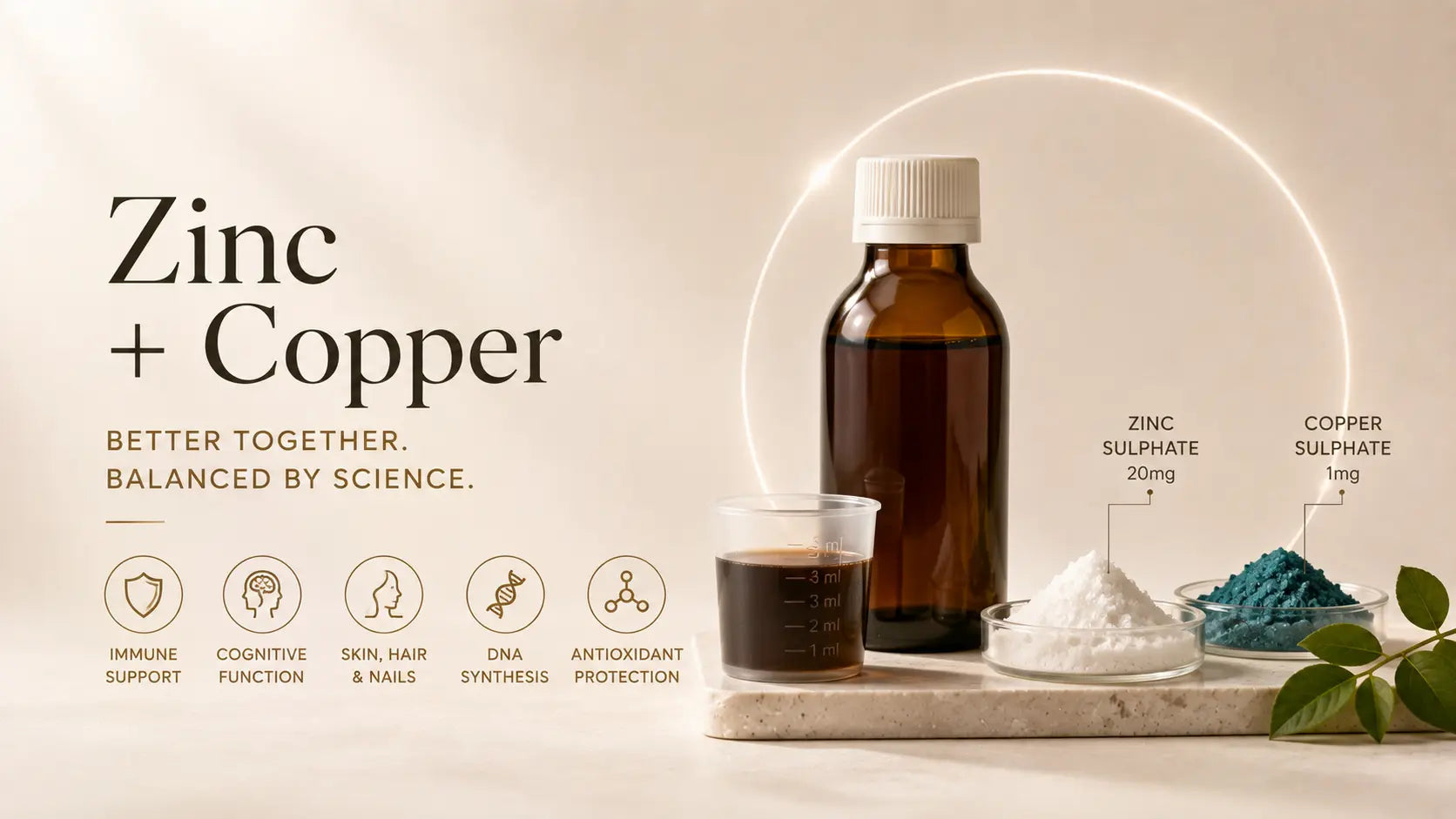
Zinc is one of the most commonly supplemented minerals in the world. Copper is one of the least discussed. The relationship between them is the reason a well-formulated zinc supplement includes both.
What zinc contributes
Zinc is involved in a remarkable number of processes — it acts as a cofactor for hundreds of enzymes. Among the contributions that are well established:
- Contributes to the normal function of the immune system
- Contributes to the maintenance of normal skin, hair and nails
- Contributes to normal DNA synthesis
- Contributes to the protection of cells from oxidative stress
- Contributes to normal cognitive function
The body has no meaningful zinc store. Unlike iron or vitamin B12, there is no reservoir to draw on, which is why intake needs to be reasonably consistent rather than occasional.
Why copper belongs alongside it
Zinc and copper are absorbed in the small intestine through overlapping pathways. In practice they compete.
Sustained zinc supplementation without copper can, over time, affect copper status. The mechanism is reasonably well characterised: high zinc intake increases production of a binding protein in the intestinal lining that has a stronger affinity for copper than for zinc, so copper gets trapped and excreted rather than absorbed.
This is not a reason to avoid zinc. It is a reason to prefer a formulation that accounts for it. A supplement providing both in a sensible ratio sidesteps the issue entirely.
Copper has its own contributions:
- Contributes to the maintenance of normal connective tissue
- Contributes to normal iron transport in the body
- Contributes to normal hair and skin pigmentation
- Contributes to the protection of cells from oxidative stress
Why a syrup rather than a tablet
Three practical reasons.
Dosing flexibility. A liquid can be measured to the millilitre, which matters when the appropriate amount differs between an adult and a child.
Swallowing. A meaningful number of people — particularly older adults and children — struggle with tablets, and a supplement that does not get taken does nothing.
No disintegration step. A liquid arrives already dissolved.
Taking it sensibly
Zinc on an empty stomach causes nausea in a lot of people. Taking it with or shortly after food usually resolves that.
Space it apart from iron supplements and from calcium if you take either — the same absorption competition applies. Two hours is generally sufficient.
Use the measuring cap rather than estimating with a kitchen spoon. Household spoons vary by a factor of two.
Who should speak to a doctor first
Anyone who is pregnant or breastfeeding, anyone taking regular medication — certain antibiotics interact with mineral supplements — and anyone giving supplements to a child.
Also worth saying plainly: a supplement supplements a diet. Zinc occurs in meat, shellfish, legumes, seeds and whole grains, and copper in nuts, seeds, whole grains and organ meats. If your diet is varied, you may not need supplementation at all. It becomes more relevant with restricted diets, higher requirements, or where a doctor has identified a shortfall.
Orbit Naturals has been formulating at our own facility in Rawalpindi since 1998. Our Addjust Syrup provides Zinc Sulphate 20mg and Copper Sulphate 1mg per 5ml, developed and manufactured in-house.
Food supplement. Not a substitute for a varied and balanced diet or a healthy lifestyle. Do not exceed the recommended intake. Keep out of reach of children. Consult your physician before use if pregnant, breastfeeding, or taking other medication. This article is general information, not medical advice.