Cart
0
Bone is not inert. It is living tissue that is continuously broken down and rebuilt throughout your life, and the balance between those two processes shifts with age.
Understanding that balance explains why bone nutrition matters at every stage, not only in later life when it starts being discussed.
The building blocks
Calcium is the structural mineral. Roughly 99% of the calcium in your body sits in bones and teeth. It contributes to the maintenance of normal bones and teeth, and also to normal muscle function, normal blood clotting, and normal energy-yielding metabolism.
Vitamin D3 is what makes calcium usable. It contributes to the normal absorption and utilisation of calcium and phosphorus. Without adequate vitamin D, dietary calcium is poorly absorbed — which is why calcium alone is an incomplete approach.
Zinc contributes to the maintenance of normal bones, and to normal DNA synthesis, which underpins the constant rebuilding process.
Magnesium contributes to the maintenance of normal bones and to normal muscle function, and is involved in vitamin D metabolism.
These work as a system. Supplementing one in isolation is usually less useful than a formulation that respects how they interact.
The vitamin D problem in South Asia
There is a widespread assumption that a sunny climate rules out vitamin D insufficiency. Published research across South Asia has repeatedly found otherwise, and insufficiency is common across the region despite abundant sunshine.
Several factors contribute. Cultural and practical clothing coverage limits skin exposure. Increasingly indoor work and study patterns reduce it further. Deeper skin tones have more melanin, which is protective against UV damage but slows vitamin D synthesis, requiring longer exposure for the same output. Air quality in urban centres reduces the UVB actually reaching ground level. And dietary sources are limited — oily fish, egg yolk and fortified products, none of which feature heavily in most local diets.
The result is that living somewhere sunny turns out to be a poor predictor of vitamin D status.
When it matters most
Childhood and adolescence. The majority of adult bone mass is laid down before the age of twenty. This is the accumulation phase, and it does not come round again.
Pregnancy and breastfeeding. Requirements rise substantially. Supplementation here should always be discussed with a doctor.
Women after menopause. The decline in oestrogen accelerates bone turnover, and bone density loss becomes faster in the years following.
Older adults generally. Absorption efficiency declines, dietary intake often falls, and outdoor time typically reduces.
What supplements cannot do
Bone health is not solved by a tablet, and it is worth being clear about that.
Weight-bearing exercise is the strongest single lever. Bone responds to mechanical load by increasing density. Walking, stair climbing and resistance training all count. No supplement replicates this.
Diet comes first. Dairy, leafy greens, sesame, almonds, and small fish eaten with bones are all meaningful calcium sources.
Not smoking matters, as smoking is associated with reduced bone density.
Supplements fill gaps in that picture. They do not substitute for it.
Practical points
Calcium absorption is better in doses of 500mg or less, so splitting a larger daily amount across the day is more effective than taking it all at once.
Take calcium apart from iron and zinc supplements — two hours is generally enough — because they compete for absorption.
Vitamin D is fat-soluble, so taking it with a meal containing some fat improves uptake.
If you are concerned about your bone health, a doctor can assess your vitamin D status with a blood test and arrange a bone density scan where appropriate. That is a better starting point than guesswork.
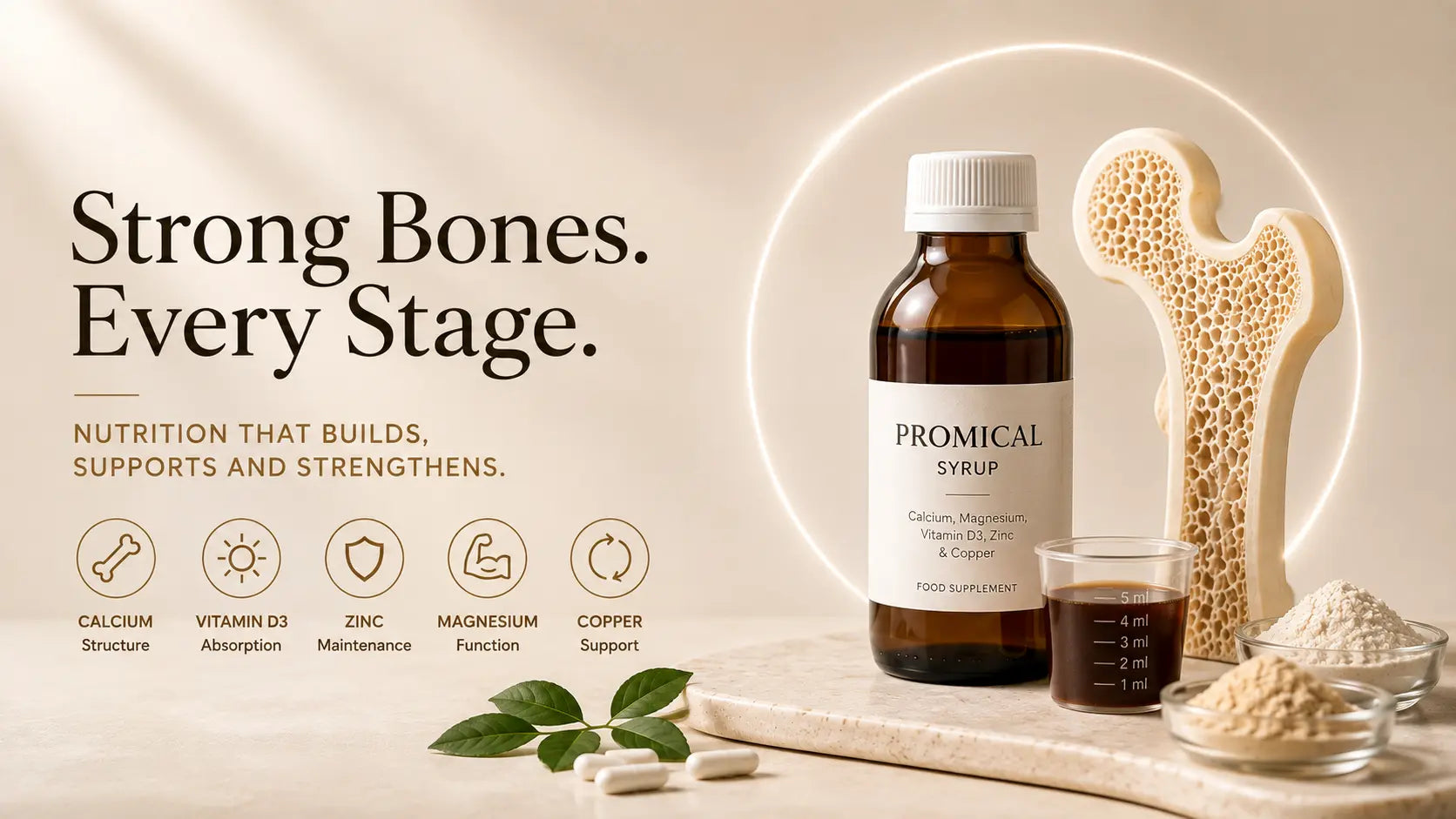
Orbit Naturals has been formulating at our own facility in Rawalpindi since 1998. Our Promical Syrup provides Calcium, Magnesium, Vitamin D3, Zinc and Copper, developed and manufactured in-house.
Food supplement. Not a substitute for a varied and balanced diet or a healthy lifestyle. Do not exceed the recommended intake. Keep out of reach of children. Consult your physician before use if pregnant, breastfeeding, or taking other medication. This article is general information, not medical advice.