Cart
0
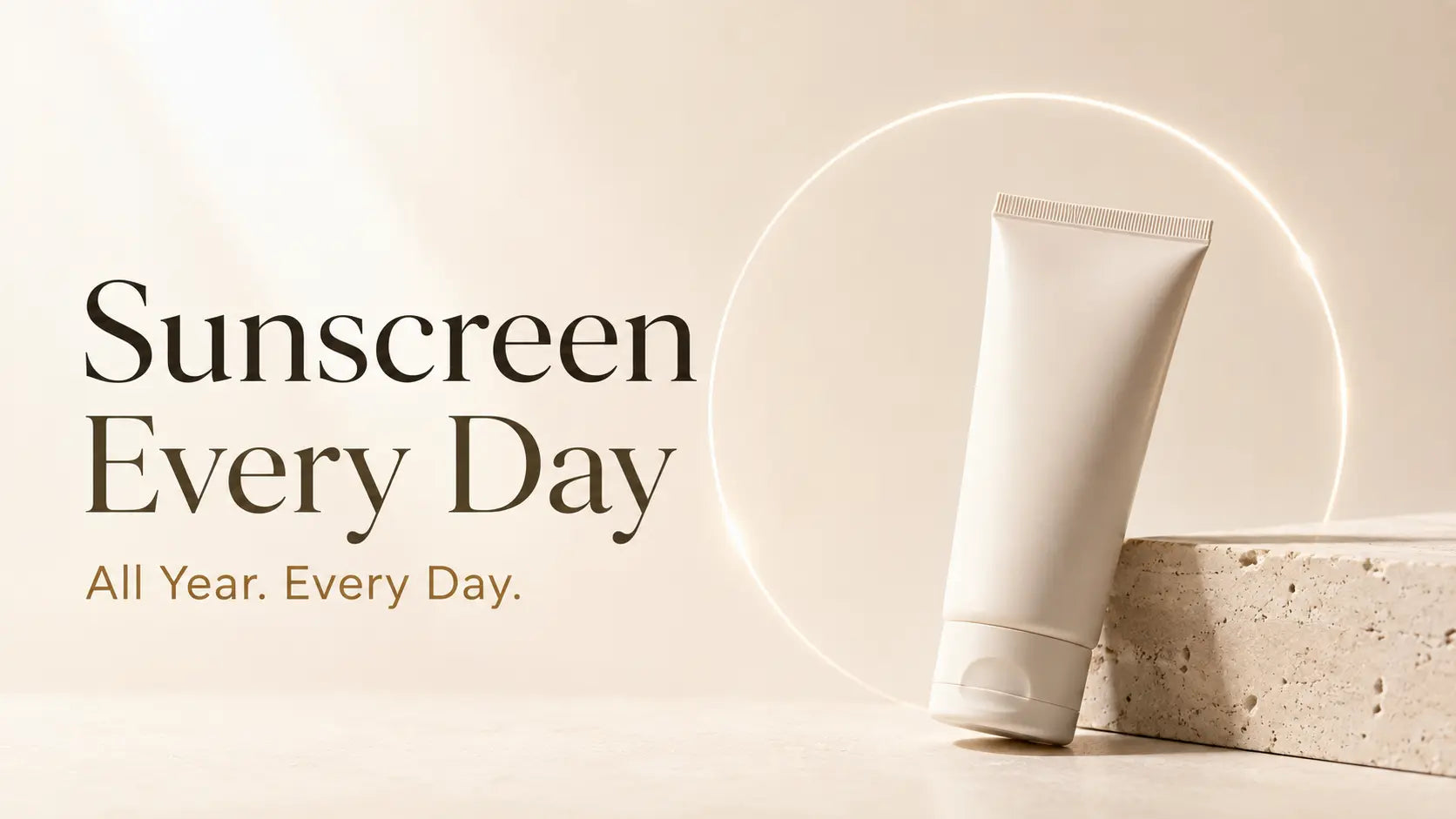
Most people in Pakistan think of sunscreen as something you use on a beach holiday. It gets bought in May and forgotten by October. That habit is the single biggest gap in the average skincare routine here, and closing it does more for your skin than any serum you could buy.
UV does not take winters off
There are two kinds of ultraviolet radiation that matter for skin.
UVB is the one most people know. It is strongest in summer and in the middle of the day, and it is responsible for sunburn. This is the type that makes sunscreen feel seasonal.
UVA is the one that changes the argument. It stays relatively constant across the year, it is present from early morning to late afternoon, and it penetrates deeper into the skin. UVA is the wavelength most associated with visible ageing — loss of firmness, uneven tone, and the pigmentation that builds up slowly over a decade.
UVA also passes through window glass. If you sit near a window at work, or drive regularly in Rawalpindi or Islamabad traffic, you are getting meaningful exposure on the days you would never think to apply sunscreen.
Why this matters more here than in cooler climates
Pakistan sits at a latitude with high year-round UV. Even in December, midday UV index readings in Punjab regularly reach levels that would be considered a summer peak in northern Europe.
There is a second factor. Deeper skin tones have more natural photoprotection against burning, which is genuinely protective — but that protection does not extend equally to pigmentation. Melasma and post-inflammatory hyperpigmentation, two of the most common concerns brought to dermatologists in this region, are both driven and worsened by UV exposure.
Put simply: many people here will not burn, so they assume they are not being affected. The pigment on their cheeks says otherwise.
Reading the label
SPF measures protection against UVB. SPF 30 filters roughly 97% of UVB. SPF 50 filters roughly 98%. That difference sounds trivial, but it matters more in practice than on paper, because almost nobody applies enough to achieve the rated protection.
Broad-spectrum means the product also filters UVA. Without this on the label, you are only protected against burning, not against the ageing and pigmentation side.
Water and sweat resistant matters in a climate where you will sweat through a formulation by mid-morning.
The mistake almost everyone makes
Under-application. The rated SPF on a bottle is measured using 2mg of product per square centimetre of skin. In real terms that is roughly half a teaspoon for the face and neck alone.
Most people apply about a quarter of that, which does not give you a quarter less protection — the relationship is not linear, and the practical result is often closer to a third of what the label says.
A useful method: two full finger-lengths of product squeezed onto your index and middle fingers, applied to the face and neck. It will feel like too much the first few times. It is not.
Building the habit
- Apply as the final step of your morning routine, after moisturiser
- Give it 15 minutes before going outside
- Reapply every two hours if you are outdoors, and after swimming or heavy sweating
- Do not skip cloudy days — cloud cover reduces UVB noticeably but UVA far less
- Do not skip winter
If you take one thing from this: a moderate sunscreen used every single day beats an excellent sunscreen used occasionally. Consistency is the whole game.
Orbit Naturals has been formulating at our own facility in Rawalpindi since 1998. Our Sun Shield SPF 50+ is a broad-spectrum, water and sweat resistant formulation developed and manufactured in-house.
This article is general information, not medical advice. Sun protection is one part of sun-safe behaviour — seek shade and cover up during peak hours. For persistent pigmentation concerns, consult a dermatologist.