Cart
0
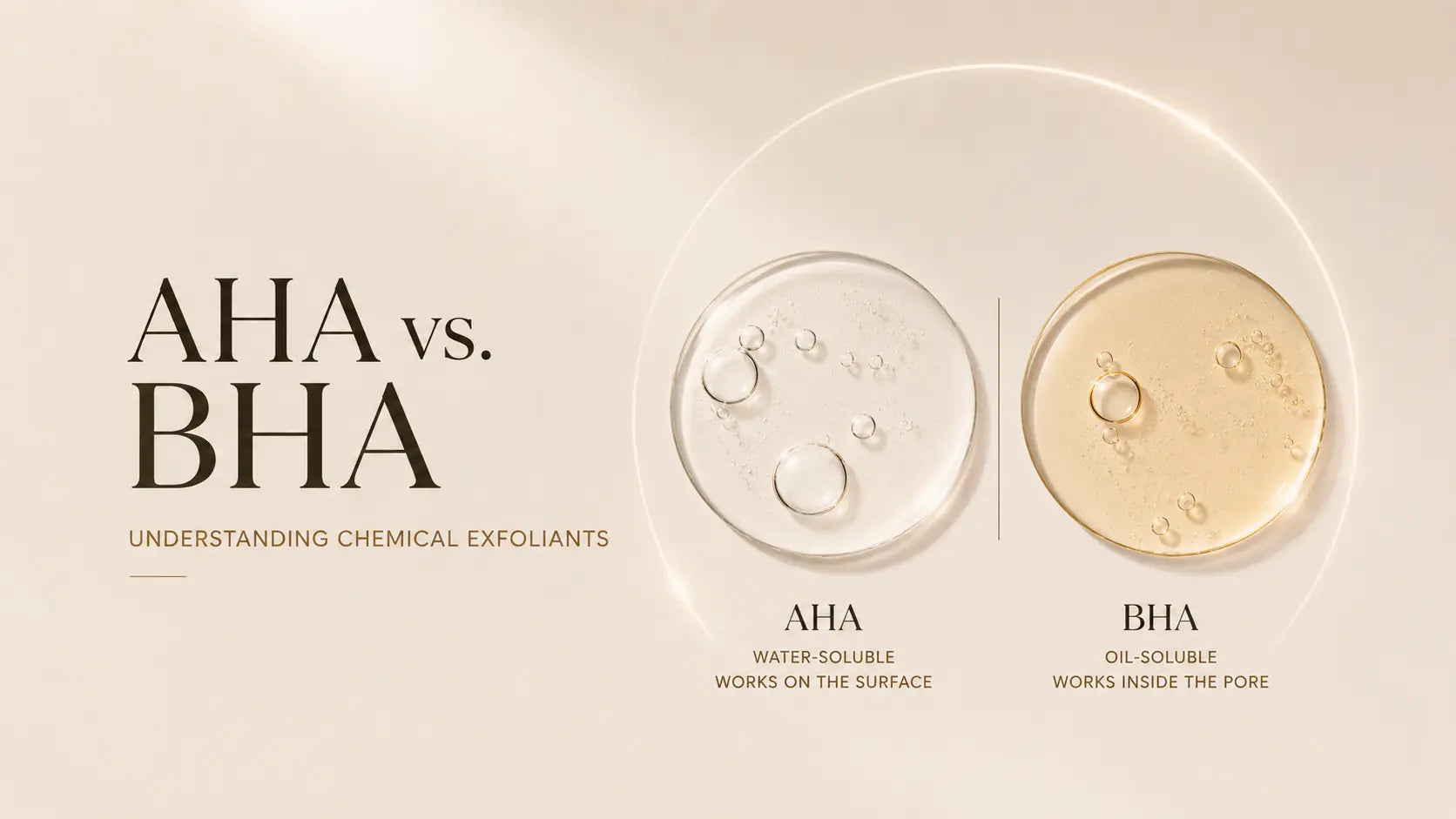
Chemical exfoliants confuse people more than any other category in skincare. The labels are alphabet soup — AHA, BHA, PHA, glycolic, lactic, salicylic — and the products all promise smoother, clearer skin without explaining how they differ.
The distinction is simpler than it looks, and it comes down to one property: whether the acid dissolves in water or in oil.
AHAs work on the surface
Alpha hydroxy acids are water-soluble. That means they stay on the skin surface and work on the outermost layer, helping loosen the bonds between dead cells so they shed more evenly.
The most common is glycolic acid, derived from sugar cane. It has the smallest molecule of the group, so it penetrates most readily — which makes it the most effective and also the most likely to sting. Lactic acid is the gentler alternative, with a larger molecule and a mild hydrating effect.
Because AHAs work on the surface, they are best for concerns you can see on the surface: rough texture, dullness, uneven tone, and the general look of tired skin.
BHAs work inside the pore
Beta hydroxy acid — in practice this means salicylic acid — is oil-soluble. This single property changes everything about how it behaves.
Your pores are lined with sebum. A water-soluble acid cannot get through that; an oil-soluble one can. Salicylic acid travels into the pore and works on the mix of oil and dead cells that congests it.
That makes BHA the right choice for blackheads, congestion, enlarged-looking pores, and blemish-prone skin. It is also anti-inflammatory in character, which is why it tends to calm rather than aggravate reactive skin.
So which do you need?
- Rough or bumpy texture — AHA
- Dullness, uneven tone — AHA
- Blackheads and congestion — BHA
- Oily skin, enlarged pores — BHA
- Blemish-prone skin — BHA
- Dry skin needing smoothing — AHA, lactic acid specifically
Most people have more than one of these, which is why formulations combining both have become standard. A toner pairing glycolic with salicylic covers surface texture and pore congestion in a single step.
How often, and how to start
The most common mistake with acids is not choosing the wrong one. It is using the right one too often.
Over-exfoliation does not look like irritation at first. It looks like unusually smooth, slightly shiny skin — which feels like success, so people do it more. Then the barrier gives way: stinging, redness, sudden sensitivity to products that never bothered you, and paradoxically more breakouts.
A sensible progression:
- Weeks 1–2 — twice a week, evenings only
- Weeks 3–4 — three times a week if your skin is comfortable
- Ongoing — three to four times a week is plenty for most people
Daily acid use suits very few people, and nobody needs it to see results.
What not to combine
Do not use acids on the same night as retinol unless your skin is well accustomed to both. Alternate nights instead — acids one evening, retinol the next.
Avoid acids on skin that is already irritated, sunburnt, or broken. If your barrier is compromised, repair it first with simple moisturiser and time.
And the non-negotiable one: exfoliating acids increase your skin's sensitivity to sunlight. Daily sunscreen is not optional alongside them. Using acids without SPF can leave you worse off on tone than if you had used nothing at all.
What to expect
Texture changes come first, usually within two weeks. Tone and clarity take longer — six to twelve weeks of consistent use. If you see no change after three months at a sensible frequency, the concentration is probably too low for your skin rather than the ingredient being wrong.
Orbit Naturals has been formulating at our own facility in Rawalpindi since 1998. Our AHA/BHA Exfoliating Toner combines Glycolic and Salicylic Acid in a single evening step, developed and manufactured in-house.
This article is general information, not medical advice. Patch test before first use. For persistent skin concerns, consult a dermatologist.