Cart
0
Walk into any pharmacy in Pakistan, or scroll any online marketplace, and you will find hundreds of supplements making similar promises at wildly different prices. Here is how to tell them apart, from a manufacturer that has been filling these bottles since 1998.
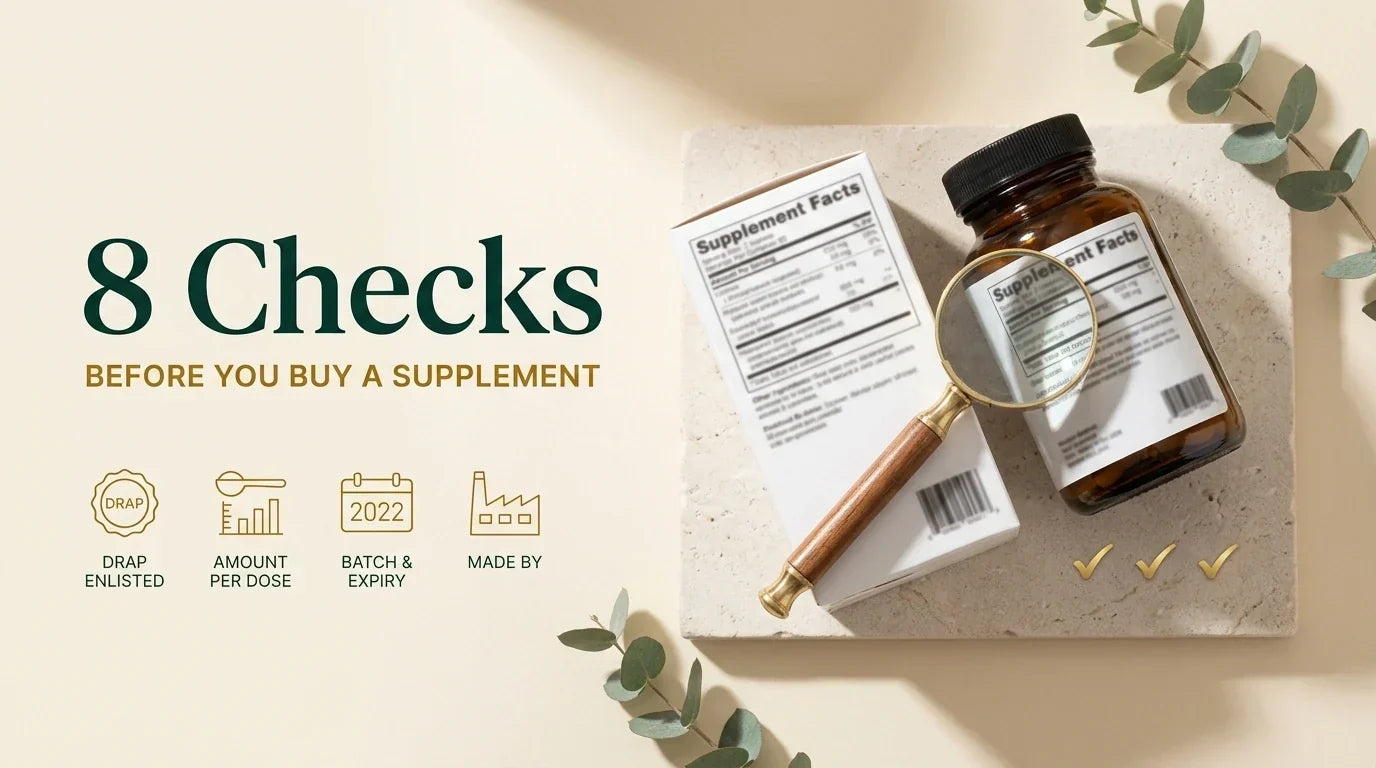
1. Look for the DRAP enlistment number
Nutraceuticals and health supplements sold legally in Pakistan are enlisted with the Drug Regulatory Authority of Pakistan. An enlisted product has been through a documented process covering the formulation, the manufacturing site and the label.
The number should be printed on the pack. If a product does not carry one, you have no way of knowing who made it or under what conditions. More than 150 of our products are DRAP-enlisted, and every pack carries its number.
2. Check the amount, not just the ingredient
The front of a pack tells you what is in it. The back tells you how much. Those are very different things.
A label that says "contains ginseng, ginkgo and zinc" without amounts is telling you almost nothing. Look for a panel giving the quantity per tablet, capsule or measured dose, in mg or mcg. Where an extract is used, a good label also states the strength of that extract.
This is the single fastest way to compare two products that look identical on the shelf.
3. Understand the dose format
"Each 10ml contains" and "each 5ml contains" are not the same claim, and syrups are frequently compared incorrectly because of it. Check the serving size the amounts refer to, and how many servings the pack holds. A larger bottle at a higher price can easily be the cheaper product per dose.
4. Be wary of language that promises too much
Food supplements support normal body functions. They do not treat, cure or prevent disease, and in Pakistan as elsewhere it is not legal to sell them as if they did.
Wording like "cures", "guaranteed results in 7 days", or claims about a named disease should make you cautious about everything else on the label. Honest supplement labels sound duller, because the permitted claims are narrower.
5. Check who actually made it
Many brands are marketing companies that outsource production. That is perfectly normal, and we manufacture for other companies ourselves. What matters is that someone identifiable is responsible for the product and reachable if something is wrong.
Look for a manufacturer's name and address, a batch number, a manufacturing date and an expiry date. A pack without a batch number cannot be traced or recalled.
6. Storage tells you something too
Pakistani summers are hard on supplements. Heat and humidity degrade vitamins, and syrups and softgels suffer worst. Buy from somewhere that stores stock sensibly, keep bottles out of direct sun and away from the kitchen window, and close caps properly. If a syrup has changed colour or smell, do not use it.
7. Ask whether you need it at all
The most expensive supplement is the one you did not need. Before buying, it is worth asking:
- Is there a gap in my diet I could close with food instead?
- Do I know my levels, or am I guessing? Tests for iron, vitamin D and thyroid function are inexpensive in Pakistan.
- Am I already getting this from something else I take? Multivitamins overlap constantly.
- Am I buying this for a symptom that deserves a doctor's opinion?
8. Two things worth checking with a pharmacist
Supplements interact with medicines more often than people expect. Two common examples: ginkgo and other botanicals can interact with blood-thinning medication, and minerals such as calcium, zinc and magnesium can interfere with the absorption of some antibiotics if taken at the same time.
If you take regular medication, are pregnant or breastfeeding, or are buying for a child, a two-minute conversation with a pharmacist is worth more than an hour of reading online.
If you want to see how we apply all of this, our product pages list ingredient amounts per dose, and our About page explains how the factory works.
This article is general information from the Orbit Naturals formulation team, not medical advice. Our supplements are food supplements, not medicines, and are not intended to diagnose, treat, cure or prevent any disease.